AI governance is the framework of policies, processes, technologies, and oversight systems used to ensure artificial intelligence is used safely, responsibly, ethically, and in compliance with organizational and regulatory requirements.
AI governance helps organizations monitor AI systems, manage risks, protect sensitive data, enforce policies, and maintain accountability across AI usage.
In healthcare, AI governance is especially important because AI systems interact with patient data, clinical workflows, operational systems, and regulatory requirements.
As healthcare organizations rapidly adopt AI technologies, governance becomes essential for reducing risk and maintaining trust.
Without AI governance, organizations may face:
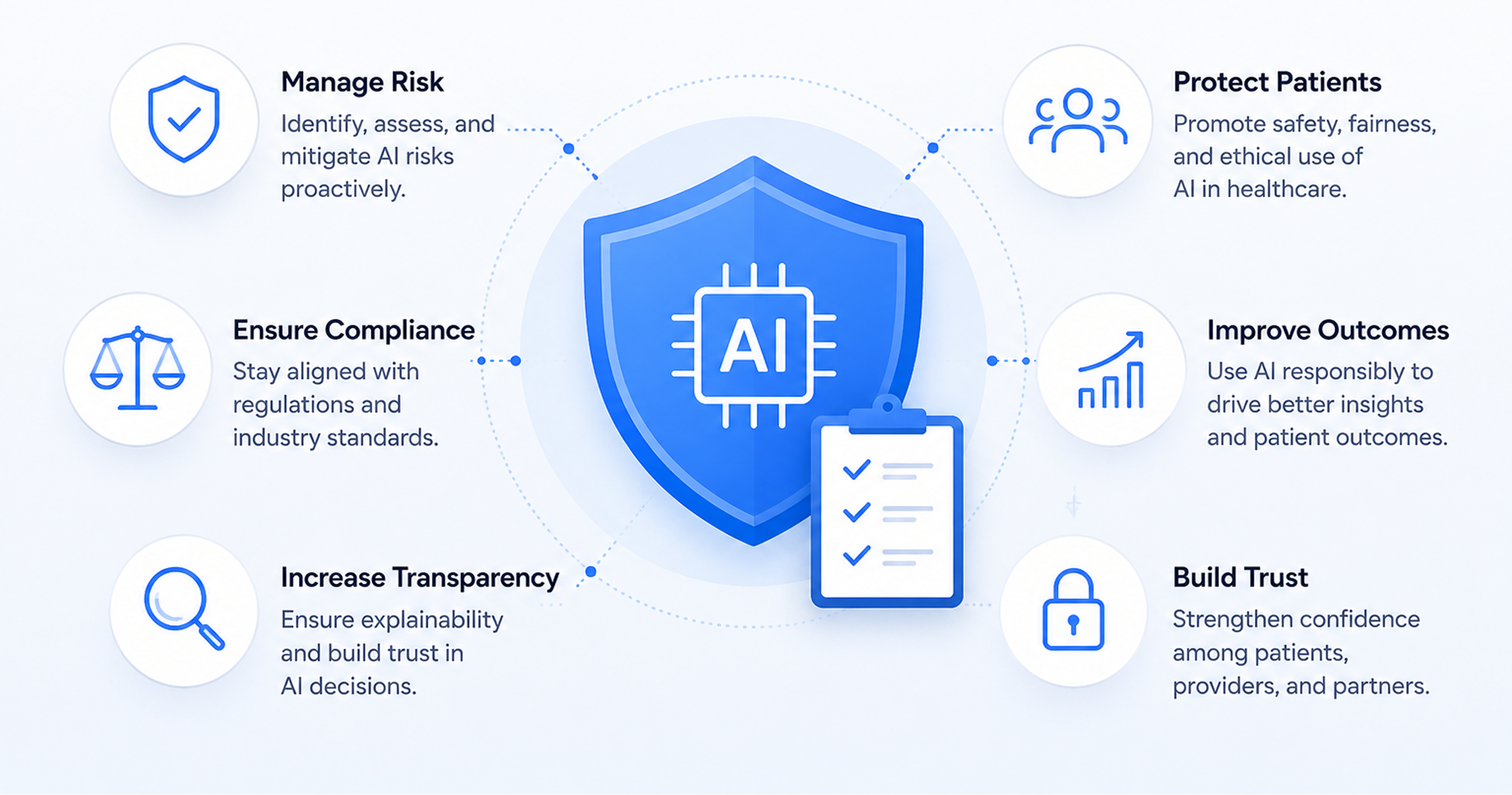
AI governance enables organizations to safely scale AI adoption while maintaining compliance, transparency, and accountability.
A strong AI governance program typically includes:
Identifying all AI tools, models, agents, and automated systems used across the organization to establish complete visibility and centralized AI inventory management.
Evaluating AI systems for privacy, security, operational, ethical, and compliance risks to ensure responsible deployment and reduce organizational exposure.
Defining acceptable AI usage policies, governance standards, access controls, and operational guardrails to enforce secure and compliant AI adoption.
Monitoring AI activity, generated outputs, user interactions, and policy violations in real time to detect misuse, anomalies, and compliance breaches.
Maintaining governance documentation, audit trails, risk assessments, and regulatory alignment records to support transparency, accountability, and audit readiness.
Assessing third-party AI vendors, platforms, and service providers for compliance, security practices, data protection standards, and governance maturity before adoption.
Healthcare organizations benefit from AI governance through a structured lifecycle:
Identify all AI tools, models, agents, and automated systems used across the organization to establish complete visibility and centralized AI inventory management.
Evaluate AI systems for privacy, security, operational, ethical, and compliance risks to ensure responsible deployment and reduce organizational exposure.
Monitor AI activity, generated outputs, user interactions, and policy violations in real time to detect misuse, anomalies, and compliance breaches.
Maintain governance documentation, audit trails, risk assessments, and regulatory alignment records to support transparency, accountability, and audit readiness.
Assess third-party AI vendors, platforms, and service providers for compliance, security practices, data protection standards, and governance maturity before adoption.
The AI governance lifecycle is the continuous process of governing AI systems throughout their usage.
Organizations benefit from AI governance by:
AI governance creates a safer and more controlled AI environment across the organization.
Traditionally, governance and policies have been on static PDFs and enforced on semi-regular schedules. Usually organizations have policies that are deployed by attestation ex. “Employees may not use AI systems to research or analyze topics related to [X].”. This creates HR enforceability, not technical enforcement, which leaves numerous risks and Health System exposed, particularly as Health Systems are adopting more and more AI vendors. AI governance as a platform is the modern way to apply policies and rules to evolving technology. It moves from static, irregularly updated PDFs to technology infrastructure that evolves and applies policies and guardrails at the speed of AI adoption.
Vitea operates as an independent governance layer across your AI ecosystem. It provides continuous visibility into both vendor and internally developed AI, and can enforce real-time guardrails if applications behave outside of your clinical, security, or compliance policies without disrupting operations.
Yes, Vitea is built for enterprise health systems where AI usage is constantly expanding. It continuously discovers, inventories, and governs both sanctioned and shadow AI across departments, vendors, and users, without requiring point integrations for every new tool.
Cybersecurity is critical for health systems due to rising risks and the value of data. Cybersecurity protects your network perimeter and endpoints. Vitea protects how AI behaves inside your environment and how it interacts. It adds a dedicated AI governance layer that monitors model behavior, data flow, and policy compliance complementing existing security investments rather than replacing them.
Yes, Vendor monitoring focuses on the safety and performance of their product. Vitea provides independent, enterprise-wide oversight across all AI in your health system including shadow AI, embedded AI within enterprise platforms, and cross-vendor risk exposure.
More importantly, Vitea enables health system–specific guardrails aligned to your internal policies, risk tolerance, and operational standards - something no generic vendor can configure for you. For example, if your policy prohibits sending discharge summaries or unapproved PHI fields to external AI tools, Vitea can enforce that rule in real time across any chatbot or AI application in use even if the vendor itself allows it. AI governance must be system-level, policy-driven, and tailored to your environment not dependent solely on vendor assurances.
Most health systems gain actionable visibility within days including discovery of previously unknown AI usage, policy gaps, and data exposure risks. This requires minimal operational lift from your side due to our FDE (Forward Deployed Engineer) model.
The platform immediately surfaces previously unknown AI applications, browser plug-ins, free tool usage, policy gaps, and potential data exposure risks.Within the first several weeks, organizations typically identify shadow AI activity, workflow misalignments, and areas where existing security controls are not aligned to AI use.
From there, initial enterprise policies are configured, tested, and actively enforced, often within the first 60 days — moving the organization from visibility to measurable governance.
Beyond mitigating risk, Vitea helps health systems optimize AI spend, compare vendor performance, eliminate redundant tools, and align AI adoption to measurable ROI. Governance becomes not just protection but strategic enablement.







.svg)