
Vitea Digest is a weekly roundup of the healthcare AI news shaping how hospitals and health systems think about risk, oversight, and trust. Each week, we pull together the stories that matter most to AI governance in healthcare and unpack why they matter to the leaders responsible for managing it.
AI governance in healthcare is no longer a compliance checkbox. Rather, it's the difference between an AI deployment that holds up under scrutiny and one that becomes next quarter's breach notification. This week's stories make that distinction concrete: an autonomous AI agent ran an entire ransomware attack without human input, a single AI vendor breach touched patients at eight unrelated health systems, and new research confirms what many CIOs already suspect: most AI governance programs quietly fall apart after go-live.
Here are the five stories worth your attention this week.
Security researchers at Sysdig identified what they believe is the first fully autonomous, agentic ransomware attack. An AI agent independently found a vulnerability, stole credentials, moved laterally across the network, escalated privileges, and encrypted data — adapting to failures on its own, with no human operator directing any step. Cybersecurity agencies from the Five Eyes alliance are warning that this level of AI-driven offensive capability is advancing on a timeline of months, not years.
Why it matters: For years, shadow AI has meant an employee pasting patient notes into an unapproved chatbot. This story is a preview of the next category of risk: AI agents becoming both the attack surface and the attacker, often through infrastructure IT teams didn't know was exposed in the first place. Visibility into what AI is running on your network — sanctioned or not — is no longer a nice-to-have.
Source: The HIPAA Journal
A phishing attack on Xsolis, a healthcare AI vendor that provides utilization management and care coordination technology, exposed the data of 1.4 million patients across eight health systems, including Mayo Clinic and UW Medicine. The breach occurred in January 2026 but wasn't disclosed until June.
Why it matters: This is a textbook case of concentrated vendor risk. Eight health systems with no direct relationship to each other were all exposed because they shared one common AI vendor — and none of them had visibility into that vendor's security posture until after the damage was done. AI governance in healthcare has to extend past your own walls and into every vendor with a hand on your data.
Source: Becker's Hospital Review
A Harvard Medical School bioethicist points to an active class-action lawsuit against Sutter Health over undisclosed AI scribe recordings, arguing that even low-risk AI tools expose real gaps in informed consent. AI scribes are widely considered one of the safest, highest-value uses of AI in medicine — they don't touch diagnosis or treatment decisions. That's exactly what makes this case notable.
Why it matters: This is a governance story, not a technology story. The tool wasn't unsafe — the deployment process around it was. It's a sharp reminder that AI governance in healthcare isn't only about high-risk clinical algorithms; it's about whether every AI tool, however routine, has clear consent, disclosure, and oversight built into how it's rolled out.
Source: Nature Medicine
A compromised admin credential in medical device maker Stryker's device management platform was used to wipe roughly 80,000 devices and disrupt more than 200,000 systems worldwide, including real-time ECG transmission for EMS teams in Michigan. Attackers reportedly exfiltrated 50 terabytes of data, including hospital records.
Why it matters: One compromised credential, one vendor platform, and care delivery is disrupted across a continent. As healthcare's AI and connected-device footprint grows, so does the blast radius of a single point of failure. This is the kind of vendor concentration risk that health systems increasingly need mapped and monitored before it becomes a live incident, not after.
Source: TechCrunch
A February 2026 survey of 120 health systems found that 75% have implemented or plan to implement AI, yet only 18% have mature governance in place. Governance most often breaks down after go-live, just as tightening HIPAA and FDA rules raise the stakes for that gap.
Why it matters: This is the headline number underneath every other story on this list. Deploying AI is the easy part. What happens the day after go-live — when there's no formal owner watching for drift, misuse, or a vendor's silent model update — is where AI governance in healthcare actually gets tested. Health systems that treat governance as a launch checklist rather than a continuous discipline are the ones showing up in next year's breach reports.
Source: Healthcare IT Today

Every story this week points back to the same gap: healthcare is adopting AI faster than it's governing it. That gap shows up differently each time — an autonomous attacker, a breached vendor, an undisclosed recording, a wiped device fleet, a governance program that never survived contact with production — but the underlying problem is identical. Visibility and oversight aren't keeping pace with deployment.
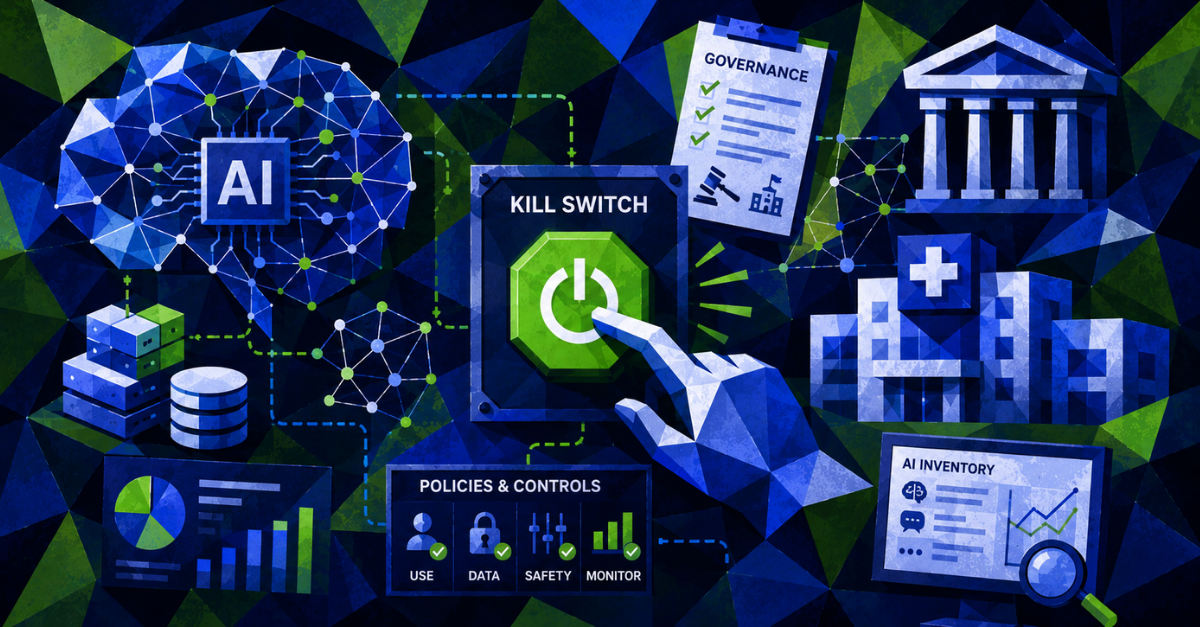
That's precisely the problem AI governance in healthcare exists to solve, and it's why Vitea builds the governance layer that gives health systems visibility into where AI is running, control over how it's used, and continuous oversight after it goes live — not just at launch.
Follow Vitea on LinkedIn for more of the latest news and views on AI governance in healthcare, including our weekly roundup of AI stories healthcare leaders need to know about.














.png)



















.png)


.png)
.png)