.png)
Your home’s security most likely has multiple layers. Alarm system, security cameras, mobile apps, motion sensor lights, deadbolts and knob locks on all exterior doors. And yet, many of us find ourselves asking the age-old question when we leave the house: did I lock the door?
Much like protecting your home, protecting your health system from bad actors is a multi-layered strategy. One that should include both AI governance in healthcare and cybersecurity.
You've spent years securing your health system's perimeter. Firewalls, endpoint detection, zero-trust architecture, HIPAA compliance programs. Your security posture is mature. Then a clinical team starts using an AI scribe tool they found on their own. A revenue cycle manager runs patient data through a public LLM to draft appeal letters. A radiologist adopts an AI diagnostic aid that wasn't on your approved vendor list.
Your SIEM didn't catch any of it. Your deadbolt layer of protection, was in fact, not locked.
This isn't a failure of your cybersecurity program. It's evidence that AI has introduced a category of risk that cybersecurity tools weren't designed to address.
Cybersecurity in healthcare is fundamentally about securing and protecting against threats from outside the system. AI governance in healthcare addresses risks that emerge from authorized and unauthorized use of artificial intelligence applications from within your system.
Cybersecurity and AI governance share surface-level vocabulary: risk, compliance, monitoring, access controls. That overlap is exactly what makes the conflation so easy and so dangerous.
Your healthcare cybersecurity program has controls built around detecting anomalies, blocking bad actors, and protecting data at rest and in transit. By securing from threats outside your system, you are reducing risks from adversaries, malware, unauthorized access, data exfiltration, and more.
AI governance in healthcare addresses a different problem entirely. When a clinician legitimately uses an AI tool that hallucinates a drug interaction, no security alert fires. When an AI model trained on biased data systematically underestimates pain levels in certain patient populations, your DLP solution has nothing to say about it. When a vendor's AI processes your patient data in ways that violate your BAA, your firewall didn't stop it because you approved the tool.
The risk surface is different. The monitoring approaches are different. The policy frameworks are different. Treating them as the same problem leaves you with a strategy that's strong on one axis and blind on the other.
The risks of having a cybersecurity-only mindset for AI oversight include:
When health systems try to govern AI purely through a security lens, several patterns emerge. Let’s dive into them.
Security monitoring watches for unauthorized network behavior and data exfiltration. It doesn't tell you that 40 employees are pasting PHI into ChatGPT because the output doesn't trigger a DLP rule. AI governance in healthcare requires visibility into what tools are being used and how, not just whether data moved somewhere it shouldn't.
Your third-party risk program evaluates a vendor's SOC2, their encryption standards, their breach history. It doesn't evaluate whether the AI model they're deploying was trained on representative data, whether it performs equitably across patient demographics, or whether its outputs are explainable enough to satisfy clinical oversight requirements. These are AI-specific risks with no analog in traditional security frameworks.
Security compliance is largely point-in-time: you assess, you remediate, you certify. AI systems drift. A model that performed well at deployment may degrade as patient populations shift, as clinical documentation patterns change, or as the vendor updates the underlying model. Governance requires ongoing monitoring of model behavior. SIEMs aren’t configured to do this.
Many health systems have published AI use policies. Few have mechanisms to enforce them at the point of use, track whether clinical staff are following them, or detect when a new AI tool enters the environment without approval. Cybersecurity infrastructure doesn't fill that gap.

The goal isn't to build two parallel programs that don't talk to each other. It's to recognize that cybersecurity and AI governance are complementary l ayers, each handling what the other cannot.
Here's where health system CISOs can start:
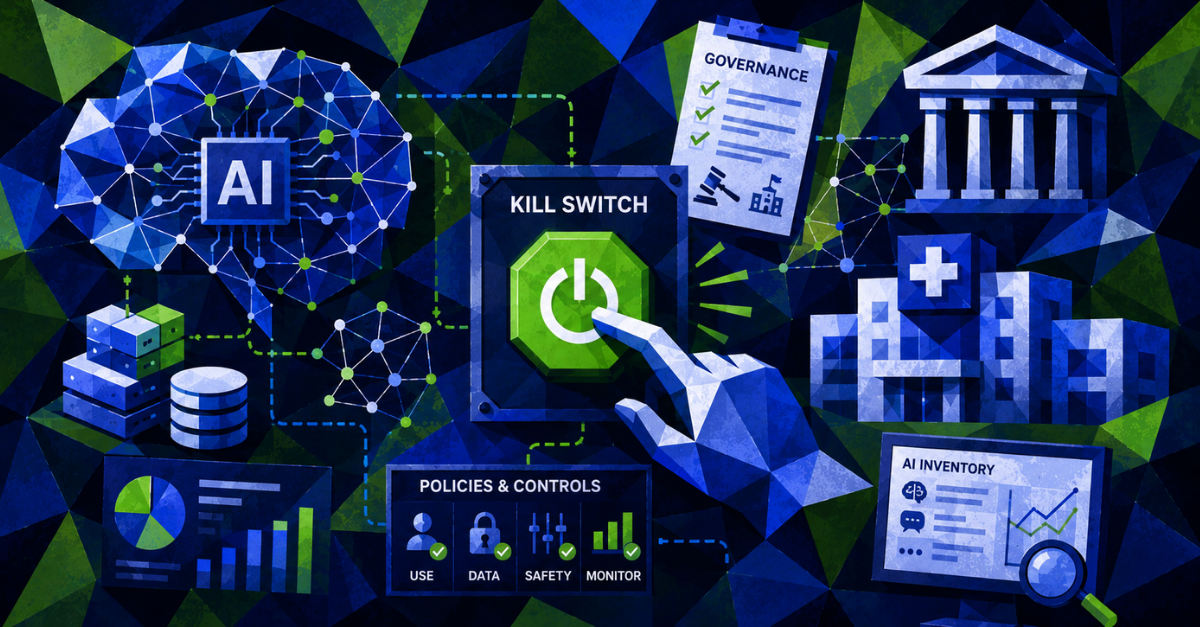
You cannot govern what you cannot see. Conduct a network-based and survey-based discovery exercise to identify AI tools currently in use across clinical, administrative, and operational functions. Include vendor-embedded AI and not just standalone tools. This inventory is the foundation everything else is built on.
What is vendor-embedded AI?
Vendor-embedded AI are artificial intelligence features that live within your applications. Common applications with vendor-embedded AI include EHRs, revenue cycle solutions, imaging software, Outlook, Salesforce.com, and Grammarly.
Develop a tiered risk framework for AI tools that goes beyond your standard vendor assessment. For example, Clinical AI that influences diagnosis or treatment decisions warrants different scrutiny than an AI tool that drafts internal emails. Risk criteria should include:
AI governance sits at the intersection of security, privacy, clinical informatics, compliance, and operations. If ownership isn't explicitly assigned, it falls through the cracks. The CISO is a natural anchor for this work, but a cross-functional AI governance committee that includes clinical representation is essential for decisions that affect patient care.
Work with your AI vendors to establish what "good" looks like for their tools, and build review cadences to detect drift. Identifying an AI governance partner can help with establishing best practices, benchmarks, tracking model performance, and incident tracking specific to AI-related errors. Don’t forget to identify clear escalation paths for when AI goes rogue.
When a clinician uses an unapproved AI tool, the instinct is to block and discipline. The better question is: what unmet need drove them to find their own solution? Shadow AI is often a symptom of governance gaps — insufficient approved tools, slow procurement processes, or policies that don't map to clinical workflows. Your governance program should create feedback loops, not just enforcement mechanisms.
AI governance isn't a distraction from cybersecurity. It's the natural extension of it. Health system CISOs who establish themselves as owners of both disciplines are better positioned to influence AI procurement decisions, shape vendor contracts, and build the organizational trust required for clinicians to actually follow AI policies.
The alternative — waiting for a patient safety incident tied to an AI tool, or a regulatory inquiry into an AI vendor's data practices — is a much harder position to recover from.
Two locks on the door. Both play a vital role in securing your home and your health system.











.png)




























.png)
.png)