
This week's healthcare AI news roundup reads like a single argument: adoption is outrunning oversight, and the gap is now showing up in courtrooms, benchmark data, and federal policy.
On July 6, a former Mayo Clinic research operations director filed a federal lawsuit that healthcare leaders will be discussing for a long time. Whatever its outcome, it marks a threshold: the first major federal whistleblower case centered specifically on AI governance failures at a health system.
The same week brought new benchmark data quantifying how few organizations can actually monitor the AI they've deployed, a federal executive order framing AI as an attack surface in critical infrastructure, and fresh evidence that AI incidents are growing far faster than the ability to respond to them.
Here are the five stories worth your attention this week.
A former Mayo Clinic research operations director — hired specifically to align the organization with federal AI governance standards — filed a federal lawsuit on July 6 alleging she was demoted and fired for reporting AI compliance failures: a concealed 67% error rate in an internal AI assistant, bypassed institutional review board processes, mishandled patient data, and unauthorized AI tools in clinical workflows. The allegations are unproven, and Mayo says it is committed to responsible AI development and cannot comment on active litigation.
Why it matters: This is the first major federal whistleblower case centered specifically on AI governance at a health system — and because it invokes the False Claims Act's retaliation provision, it suggests AI governance failures in federally funded health systems can carry federal legal exposure. Whatever the outcome, the lesson stands: when the person hired to run AI governance alleges she couldn't get visibility or accountability, that's an architecture problem, not a personnel problem. Governance that depends on individual courage is not governance.
A Black Book poll of 507 healthcare leaders finds AI has moved decisively into live EHR workflows — 67.7% of organizations are live, piloting, or evaluating ambient AI. But only 18.1% clear a basic governance threshold (a committee, impact metrics, and post-deployment monitoring), while 44% report technical readiness to integrate more third-party AI. Clinician trust in AI-generated clinical decision support sits at just 13.2%.
Why it matters: Organizations are wiring AI in more than twice as fast as they can watch it — and that 26-point gap between integration readiness and monitoring capability is where the next headline comes from. Adoption is no longer the differentiator. Governed scale is.

A Healthcare IT News feature captures how the CIO conversation is shifting from deploying AI to verifying it stays accurate in production. The structural problem: a model that is wrong is, by construction, confident it is right, so detection cannot depend on the model itself. And validation is local: vendor-reported performance doesn't reliably transfer to your patient population, documentation practices, or workflows.
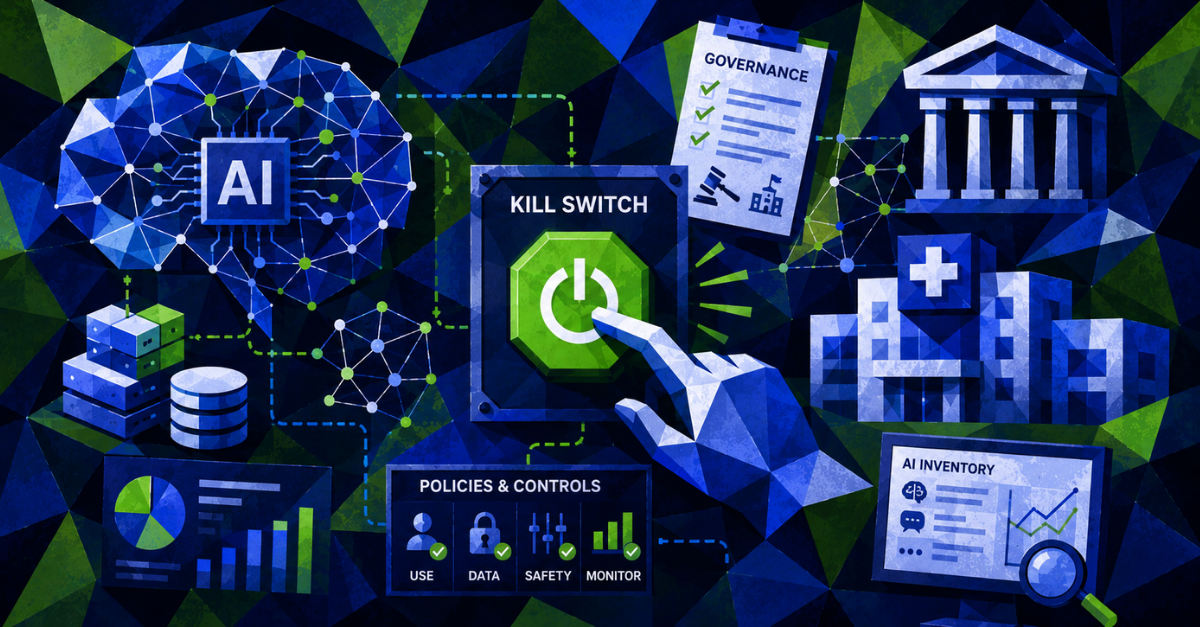
Why it matters: The prescription mirrors how healthcare already manages drugs and devices — validate before deployment, monitor continuously after, and preserve the audit trail. The recommended first step is telling: a complete inventory of every AI model operating across the enterprise. You can't govern what you can't see.
The June 2 Executive Order on Advanced AI Innovation and Security keeps the administration's innovation-first posture, but as a new legal analysis for healthcare organizations notes, it pairs acceleration with a pointed security agenda: government cybersecurity testing of advanced AI models, AI-enabled cyber defense, and explicit priority on protecting critical infrastructure — healthcare included.
Why it matters: Even a deregulatory Washington is telling healthcare that AI is part of the attack surface. For CISOs, AI can no longer sit outside enterprise cybersecurity and risk management. Governance frameworks written for accuracy and bias now need a security chapter — model manipulation, data poisoning, prompt injection, and misuse of AI-enabled workflows.
The OECD AI Incidents Monitor logged 596 AI incidents in January 2026 alone, roughly 200% year-over-year growth, according to a new argument that AI failures should be treated as operational crises.
AI incidents don't behave like software bugs: they're probabilistic, intermittent, and cross-functional, pulling in legal, compliance, communications, and clinical leadership within hours. A hallucination in a consumer chatbot is one kind of problem; a hallucination inside a clinical workflow is another category entirely.
Why it matters: Health systems have downtime procedures for the EHR. Few have one for their AI. And incident response presupposes detection — an organization cannot respond to an AI failure it never saw.
Run these stories together and the pattern is hard to miss. The Mayo complaint alleges what happens when visibility and accountability are missing. The Black Book data suggests most organizations are missing them. The CIO mandate, the executive order, and the incident numbers all explain why the cost of missing them is rising — legally, operationally, and reputationally.
AI oversight is moving from an internal aspiration to an external obligation — and the infrastructure to meet it must be built before the subpoena, the audit, or the incident makes the need undeniable.
At Vitea, we work with healthcare organizations to close exactly the gap this week's stories expose — giving health systems the visibility to know every AI tool in their environment, the policy enforcement to control it, and the audit trail to prove it. That's what makes AI governance in healthcare truly operational. If your organization is assessing its readiness, we're glad to be a resource. Get in touch with us here.
Follow Vitea on LinkedIn for more of the latest news and views on AI governance in healthcare, including our weekly roundup of AI stories healthcare leaders need to know about.









.png)



























.png)


.png)
.png)