
AI Appreciation Day gives the industry a reason to pause and acknowledge what's actually working. In healthcare, that list is longer and more substantive than it's ever been. The last six months alone have produced real, measured improvements in clinician wellbeing, diagnostic speed, and patient experience — not projections, but actual outcomes from systems already in production.
That's worth celebrating without qualification. It's also the reason the next conversation — about governance — has to happen now.
A multi-site study led by Mass General Brigham found that ambient AI documentation tools were associated with a 21.2% absolute reduction in burnout prevalence among clinicians after 84 days of use. At Emory Healthcare, the same study recorded a 30.7% absolute increase in documentation-related wellbeing. These aren't small pilot samples; the research drew on surveys of more than 1,400 physicians and advanced practice providers across both systems.
The pattern holds elsewhere. The Permanente Medical Group's physicians logged more than 2.5 million patient encounters using ambient AI tools over roughly 14 months, saving an estimated 15,791 hours of documentation time in aggregate. Cooper University Healthcare found its ambient AI deployment saved clinicians over four minutes per patient — adding up to roughly an hour back in a clinician's day.
And a randomized trial at UW Health, published in NEJM AI, tied ambient AI use to a clinically meaningful drop in burnout and 30 minutes of reclaimed documentation time per provider per day; the technology has since scaled to about 800 physicians and advanced practice providers across Wisconsin and Illinois.
Advocate Health has rolled out FDA-approved AI imaging models across 22 sites in Wisconsin and North Carolina, helping radiologists flag findings like pulmonary embolisms and intracranial hemorrhages sooner. The health system projects the technology will benefit nearly 63,000 patients a year through earlier detection and faster prioritization.
Meanwhile, Hartford HealthCare has deployed similar imaging AI that flags both immediate injuries and incidental findings on CT scans — for example, in trauma cases — so care teams can act sooner instead of risking a missed finding.
Hartford HealthCare's PatientGPT rollout is a useful model here: before going live, the health system ran the platform through IRB-overseen testing against 478 structured clinical transcripts designed to surface edge cases, cutting the tool's high-risk failure rate by 70% before scaling it toward 400,000+ primary care patients. The system reports zero harm events since launch. This result is a testament to what happens when validation and oversight are built into the deployment plan rather than added after the fact.
“Our goal is to harness the power of AI thoughtfully and responsibly to help improve healthcare for the patients and communities we serve. [We're partnering with Vitea to] help create the structure, oversight and accountability necessary to advance innovation while maintaining trust, safety and clinical integrity.” Barry Stein, Vice President and Chief Clinical Innovation Officer at Hartford HealthCare and founder of the Center for AI Innovation in Healthcare.
Emory University Hospital Midtown launched a virtual nursing initiative pairing AI and telehealth equipment with a remote nursing team, extending monitoring and fall-prevention support without adding bedside headcount.
Mercyhealth, the seven-hospital Illinois and Wisconsin system, automated high-volume claims coding across 10 specialties and saw a 5.1% revenue increase alongside a 50% reduction in accounts receivable days — while shifting its coders into higher-value audit work rather than replacing them.
Adoption is no longer a pilot conversation.
Three in four health systems have now implemented or are actively planning to implement at least one AI solution — a 27% increase in a single year. Among the systems that could actually measure return on investment, more than half reported at least 2x ROI.
This is what responsible, well-executed AI adoption in healthcare looks like when it works. It deserves the appreciation the day is named for.
Here's the part that doesn't get its own headline: the pace driving these results is the same pace that's outrunning oversight.
According to a recent HFMA and Eliciting Insights report, 88% of health systems are now using AI internally — but only 18% have a mature governance structure and a fully formed AI strategy to go with it. That's not a small gap. It means the large majority of systems generating results like the ones above are doing so without a consistent way to answer basic questions:
This isn't a hypothetical risk. Regulatory scrutiny is already catching up — enforcement under the EU AI Act is ramping through 2026, and U.S. health systems are facing their own version of the same pressure as boards and compliance teams start asking what's actually been deployed.
Industry analysts have started calling 2026 “the year of governance” for exactly this reason: C-suites are playing catch-up to clinicians and staff who adopted generative AI tools well before formal policy existed to govern them.
The wins above happened at health systems with the resources to run controlled pilots, publish peer-reviewed results, and scale deliberately. Most organizations don't have that runway. For every documented success story, there's a parallel one running quietly in the background — a department that adopted a tool nobody vetted, a workflow built on a model nobody's monitoring for drift, a vendor contract that never went through security review.
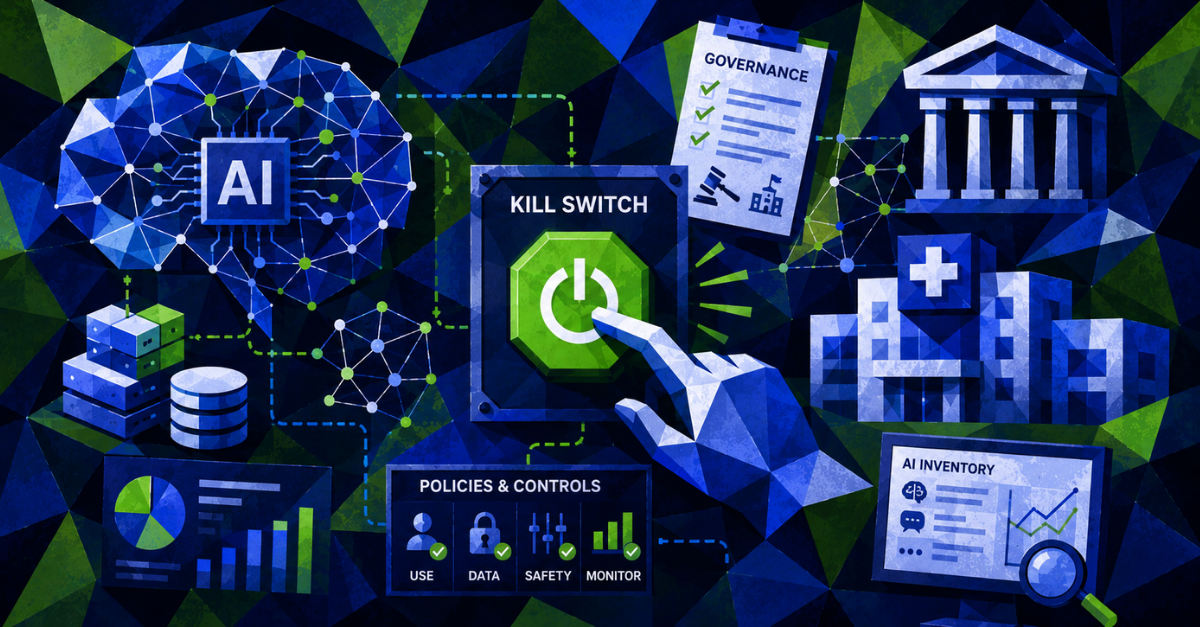
The point of governance isn't to slow down the kind of adoption described above — it's what makes it possible to scale past a single pilot without losing track of what's running, where, and on what data. In practice, that means three things most health systems still lack:
Health systems that build this layer alongside their AI programs — rather than after a lawsuit forces the issue — are the ones whose next case study won't come with an asterisk.
That's the version of AI Appreciation Day worth aiming for: genuine progress, and the infrastructure to trust it.
Vitea gives healthcare organizations full visibility into every AI tool running on their network, the ability to enforce policy on that usage in real time, and ongoing monitoring to catch problems before they become incidents. It's the governance layer that lets you say yes to AI adoption with confidence instead of crossed fingers.
Reach out to our team to see how Vitea can help your organization turn AI adoption into a strategic advantage, not a liability.









.png)
























.png)


.png)
.png)