

This week in healthcare AI news: a UK patient watchdog reported that AI scribes are getting drug names and diagnoses wrong. A leading safety organization opened a national channel for AI error reports — and admitted the data barely exists yet. A study found that when AI contradicts a doctor, patients lose trust even if the AI is mistaken. Nurses in eight cities took to the street over a hospital AI vendor's data practices. And new Pew polling put a number on how little say patients feel they have.
Read on for the top stories in healthcare AI news.
Healthwatch England, the statutory patient watchdog, reported that ambient AI scribes now used across the NHS are mishearing medications and diagnoses and carrying those errors into records and the letters patients receive. With 27 scribe products in circulation across the health service, the watchdog documented a scribe swapping a prescribed drug for a similarly named one and another dropping a clinician's instruction to renew a prescription.
In one case, a scribe's summary recorded a serious neurological condition the patient never had; she happened to be an NHS professional and questioned the entry, and only then was it corrected. The watchdog's recommended fix is unglamorous: tell patients when a scribe is in use and let them check their own notes.
Why it matters: This is a fabricated detail entering the record as fact, at national scale, with the only reliable backstop being a patient careful enough to catch it. Fluent, confident, and wrong is the hardest kind of error to spot — which is precisely why "a clinician will review it" reads as a policy but performs as an aspiration. Once an invented line is in the chart, it doesn't stay put; it follows the patient into later visits and decisions. Catching it takes monitoring that runs on every note, not spot-checks after the fact.
Source: The Guardian
Patient-safety nonprofit ECRI expanded its Problem Reporting Network so clinicians and health systems can flag AI-related errors, malfunctions, and near misses, warning that no centralized, healthcare-specific mechanism currently tracks how often AI produces bad output or how often it reaches a patient. The network has taken device and technology reports since 1972; this is its first dedicated pathway for AI.
In an accompanying ECRI survey of 124 respondents — mostly quality, safety, risk, and compliance leaders — 31% said they had encountered an incorrect or misleading AI output in the past year, 35% weren't sure, and 9% said an AI error had reached a patient or shaped a care decision. Ambient scribes were the most commonly encountered AI tool, ahead of EHR-embedded decision support and clinical chatbots.
Why it matters: Uncertainty at that scale is a visibility problem wearing a data-quality costume; an organization can't report, investigate, or prevent an error it never registered. A safety authority building the reporting rails is a start, but the reports only exist if something is watching the AI closely enough to notice when it slips.
Source: ECRI
A peer-reviewed study in the International Journal of Human-Computer Interaction ran 135 participants through a simulated consultation in which an AI assistant offered a second opinion. When the AI agreed with the clinician's recommendation, patients rated it more credible. When it disagreed, they perceived more uncertainty, judged the clinician as lazier, and reported lower trust across emotional, cognitive, and behavioral measures.
The researchers stress that disagreement is not evidence the AI is right. They pair the finding with safety-benchmark work — including the NOHARM study, which found that more than 80% of severe AI errors were omissions — meaning a confident, agreeable-sounding AI can leave out the one recommendation that mattered.
Why it matters: Patient trust is quietly becoming a governance variable, and much of the AI shaping it sits outside the health system entirely — on a patient's phone, on an account no one on staff can see. A clinician can be undermined by a tool the organization never deployed. That makes a defensible, disclosed position on how AI is used in the encounter less about compliance and more about protecting the clinical relationship itself.
Source: Telehealth.org (reporting on the study in the International Journal of Human-Computer Interaction)
National Nurses United, which represents more than 225,000 registered nurses, organized demonstrations in eight U.S. cities calling on health systems to cut ties with Palantir, citing automated staffing tools — including HCA Healthcare's Timpani platform — and what the union described as opaque data practices. The protests also folded in a separate dispute over an improperly shared Medicaid dataset, tying the vendor's work outside healthcare to questions about its role inside hospitals.
The health systems pushed back. HCA said its scheduling technology supports nurse leaders rather than replacing their judgment, and MaineHealth said its Palantir tool is limited to overturning inappropriate coverage denials and does not touch clinical decisions or control its data.
Why it matters: When frontline staff and the public start asking what an AI vendor can access and do, "the vendor handles that" is no longer an answer a health system can lean on; responsibility for a tool's behavior doesn't transfer with the contract. Answering the question requires seeing exactly what each vendor's AI touches and holding it to defined limits.
Source: Healthcare IT News
A Pew Research Center survey of 3,488 U.S. adults found that 53% feel they have little or no control over how AI is used in their healthcare, and 63% want more of a say. Nearly half (46%) weren't sure whether AI had been used in their care at all, and 72% said it's important that providers tell them when it is.
The appetite for disclosure sharpens around consequential tasks: large majorities want to be informed when AI is used to analyze medical scans (81%), make diagnoses (81%), explain lab results (80%), or take notes during appointments (72%).
Why it matters: Patient demand has turned disclosure from an ethics talking point into an operational requirement — and disclosure has a prerequisite most organizations underestimate. You can only tell a patient where AI touched their care if you can account for every place it's running in the first place.
Source: Pew Research Center, via Fierce Healthcare
The week points in one direction: the people affected by healthcare AI are no longer content to take its safety on faith. They want to see it. A watchdog wants the errors surfaced. A safety group wants them counted. A study shows trust hinges on how AI's role is explained. Nurses want to know what a vendor can reach. Patients simply want to be told.
The uncomfortable common thread is that most health systems can't yet meet that demand, because seeing their own AI in production is the exact capability they're missing. Disclosure you can't back with evidence is just reassurance, and reassurance is wearing thin.
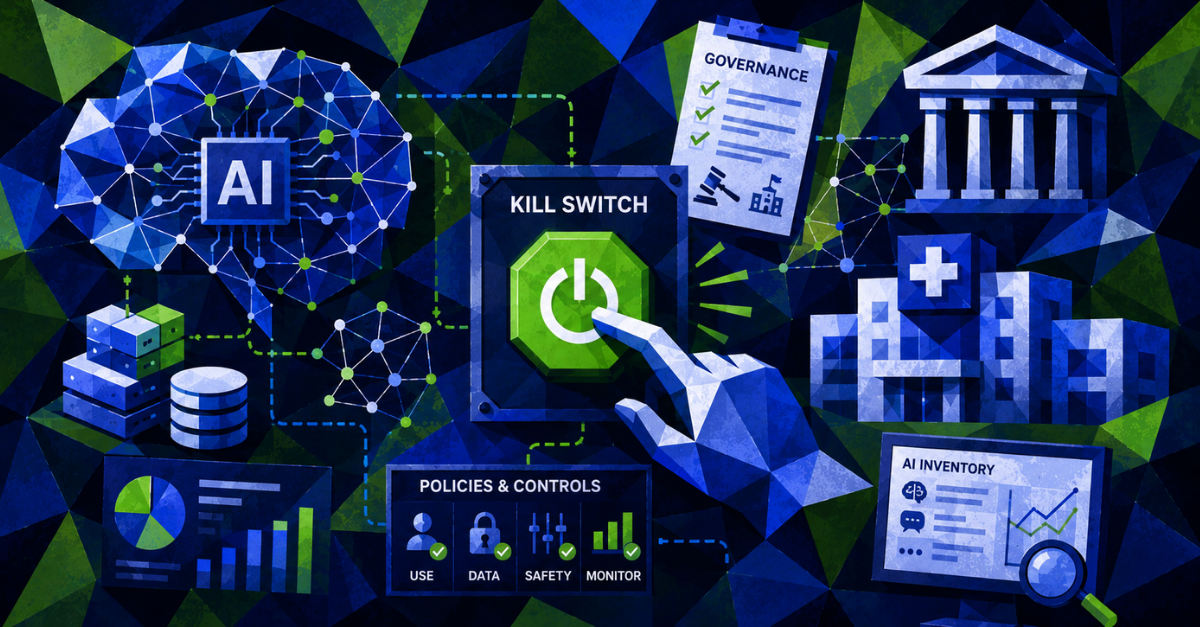
That capability is what Vitea is built to provide: the visibility to find every AI tool in the environment, sanctioned or not; the enforcement to keep each one inside the rules that apply to it, by use case and by jurisdiction; and the continuous monitoring to show it's still behaving safely well after launch.
Follow Vitea on LinkedIn for more of the latest news and views on AI governance in healthcare, including our weekly roundup of the stories healthcare leaders need to know.









.png)


























.png)


.png)
.png)