
The week's healthcare AI news in five stories: a Pennsylvania lawsuit over an ambient AI scribe, a Pew survey on human oversight, dosing errors in general-purpose AI models, Epic's response to a federal rollback and new safeguards against clinical deskilling. Each one turns on who answers for what AI does in patient care.
A Pittsburgh-area patient has sued Allegheny Health Network and Highmark, alleging that no one told her an AI scribe would record her entire visit and send the audio to an outside company. She was told an AI tool would be used. Her lawsuit argues that was not enough.
The case landed in the same week that a Pew Research Center survey found most Americans want a human making the final call when AI is involved in their care, and that federal regulators dropped a requirement for EHR vendors to disclose how their AI models were built.
For health system leaders, the stories raise one practical question: When AI is part of care, can you show what it did, who used it and under what policy?
A Pittsburgh-area woman filed a proposed class action Oct. 29 in Allegheny County Common Pleas Court against Allegheny Health Network and Highmark, TribLive reported. The suit centers on Abridge, an ambient AI scribe that AHN began using in 2024 and has since expanded to about 400 providers in more than 40 specialties, according to the complaint.
The complaint says the plaintiff was told an AI tool would be used during her appointment. It says no one explained that the tool would record her full conversation, send the audio to Abridge's servers and allow the company to keep it. The suit alleges violations of Pennsylvania's wiretap law, which requires consent from every party to a recording, along with breach of confidentiality, negligence and unjust enrichment. It also alleges that Abridge used patient recordings to train its commercial AI models. AHN and Highmark declined to comment.
Similar suits were filed in California against Sutter Health and MemorialCare in April.
Why it matters: The consent debate has moved from whether patients were told about AI to what they were told. Guidance from the Joint Commission and the Coalition for Health AI says patients should know when AI directly affects their care and how their data may be used. Meeting that standard requires knowing where each AI tool sends patient data and what the vendor may keep, which makes it a visibility question and a third-party AI question as much as a legal one.
Sixty percent of U.S. adults would be uncomfortable with their own doctor using AI for diagnoses and treatment, according to a Pew Research Center survey of 3,488 adults conducted in June and released Oct. 29. Thirty percent would be comfortable.
Acceptance depended on human review. Forty-seven percent said they were open to AI making a diagnosis if a person did a final review; 3% were open to AI doing it alone. The pattern held for lower-risk work. For AI taking notes during an appointment, 56% were open with human review and 13% without it.
Respondents were also skeptical about data protection. About half (51%) said AI will make the security of patients' health information worse, while 8% said it will improve. Only 16% expressed a great deal or quite a bit of confidence in hospital leadership to make sure AI is used in patients' best interest.
Why it matters: Patients are naming the controls they expect: a person reviewing AI output and protection for their data. Health systems that promise both will need to show where review happens, who does it and whether policy holds while a tool is in use. A written policy alone cannot show that. It takes enforcement at the point of use and a record of how tools behave over time through continuous monitoring.
Doximity tested nine widely used AI models on more than 8,500 medication dosing questions covering over 2,200 FDA-approved drugs, Healthcare Dive reported. About 19.5 of every 1,000 answers contained an error the company classified as serious or potentially lethal.
The most common mistake was failing to adjust a dose for a patient's age, kidney function or drug interactions, even when the question supplied that information. Drugs recently approved by the FDA carried five times the odds of an error.
Doximity released the findings alongside its own dose verification tool, which it says answered correctly 99.9% of the time. Other studies have reached different conclusions about how general-purpose and specialized clinical AI compare.
Why it matters: More than 81% of physicians now use AI in their practices, according to the American Medical Association. The failure the study describes, ignoring patient context that was provided, is easy to miss during a busy shift. Health systems can set which AI tools are approved for medication questions and enforce that choice where prompts are sent, including when a clinician works through a personal AI account that looks the same as the enterprise tenant on the network.
HHS finalized its HTI-5 rule Oct. 26, eliminating 14 health IT certification criteria and revising seven others. The final rule removes the AI model-card requirements that the Biden-era HTI-1 rule added for decision support tools in certified EHRs. Those requirements gave health systems information on how predictive algorithms were developed and tested. HHS estimates the change will save $1.55 billion in present-value regulatory costs.
Epic said in an Oct. 30 LinkedIn post that health systems using its software will keep access to its AI transparency documentation and its tools for evaluating fairness, validity and other attributes, Becker's Hospital Review reported. The company didn't say whether it will maintain every element of the former federal requirements.
Why it matters: Disclosure about AI built into certified EHRs is now up to each vendor. Epic has committed to keep its documentation, and other vendors may choose differently. In either case, a model card describes a tool at one point in time. Health systems still need their own view of how embedded AI behaves in production and when it changes, including when a vendor adds AI features to a tool that was approved without them.
Hospitals are setting rules for when clinicians may use AI, with the goal of keeping core skills from fading, Becker's Hospital Review reported. Children's Hospital of Philadelphia is developing a framework of "graduated privileges," under which trainees gain access to tools such as AI scribes only after showing they can do the task themselves. Some Johns Hopkins Medicine pilots require clinicians to record their own assessment before they see AI-generated input.
The Association of American Medical Colleges published AI competencies for physicians Oct. 27 that include preserving independent clinical reasoning and avoiding deskilling.
Research on the risk is mixed. An observational 2025 study in The Lancet Gastroenterology & Hepatology found that experienced endoscopists' adenoma detection rate in procedures without AI fell from 28.4% to 22.4% after AI-assisted detection was introduced. A 2026 study in Endoscopy found no significant change in unassisted performance after AI exposure. Leaders interviewed by Becker's said they have not yet found a way to measure AI's long-term effect on competency.
Why it matters: CHOP's approach grants AI access by role and demonstrated skill. Most health systems approve a tool once and make it available to everyone. Rules that depend on who is using a tool, and for what task, work only if they are enforced where the tool is used and checked over time. That puts deskilling alongside other AI patient safety risks as shared work for clinical leaders and governance teams.
This week's stories share a premise: the organization that deploys AI answers for it. A Pennsylvania lawsuit is testing that in court, and the Pew survey shows patients expect it. With federal regulators no longer requiring EHR vendors to explain their models, more of that work falls to health systems.
The practical test is whether a health system can produce the record when a patient, regulator or court asks for it. For any AI tool in clinical or administrative use, that means being able to show:
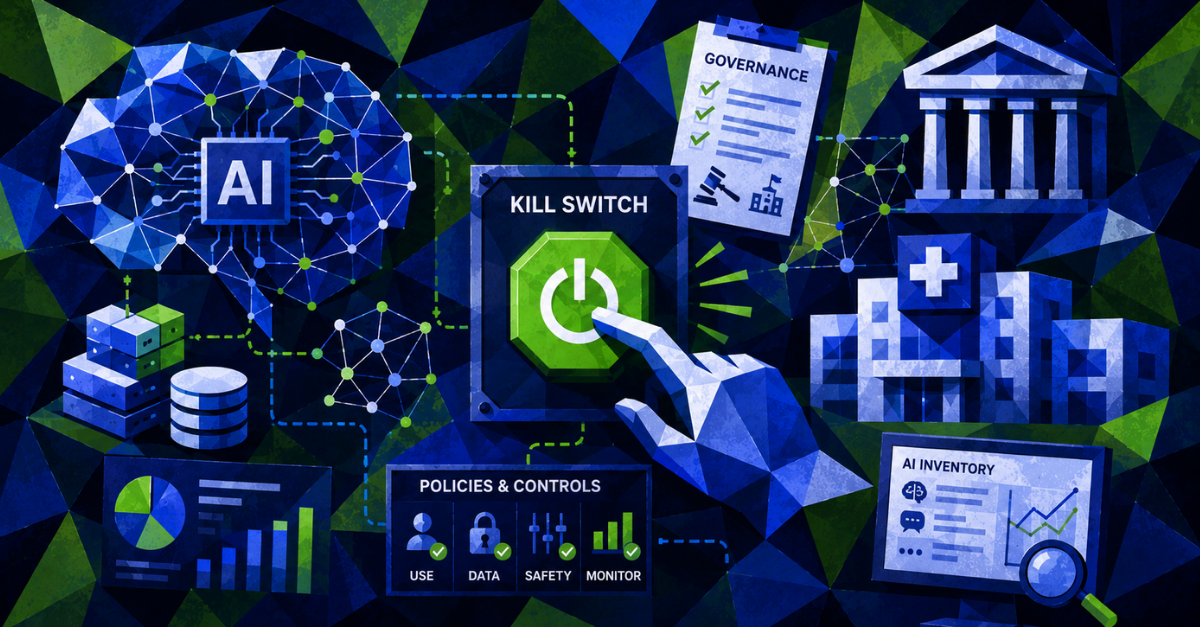
Vitea is an AI governance platform built specifically for healthcare. It enforces AI policy in real time at the point of use through Command, shows which AI tools are in use across a health system's network through Lens, and monitors how those tools behave over time through Pulse.
Talk with our team about putting real-time policy enforcement in front of the AI tools your clinicians and staff use.
Follow Vitea on LinkedIn for a weekly roundup of healthcare AI governance news.