





.svg)


Vitea Command inspects every AI prompt and response as it happens, enforcing your policies before an unsafe output reaches a patient, clinician, or EHR. Adopt AI at the pace your teams want, without gambling on the risk.

Partnering to confidently advance healthcare AI innovation.
Writing a governance policy is easy. Applying it to every application request, every prompt, every response, and every AI tool, in real time, is the part almost no health system has solved. Until something goes wrong, no one can prove the policy was ever actually followed.


Stop unsafe AI before it reaches a clinician, patient, or the EHR. Vitea enforces your policies in real time, not after the damage is done.
Real-time enforcement that turns AI policy into proof — for patient safety, compliance, and accountability.
Enforce AI governance in real time, protecting patient safety and compliance without slowing adoption.
Launch new AI tools with guardrails active from day one—not after a lengthy manual review cycle.
.svg)
Apply your organization’s rules automatically across every AI tool, user, and location.
Close the gap traditional security tools like DLP and firewalls miss. Command governs AI behavior, not just data movement or network access.
Turn every guardrail decision into audit-ready evidence for executives, regulators, and oversight teams.
Recent lawsuits involving UnitedHealth, Cigna, Sharp HealthCare, and Sutter Health reveal a dangerous blind spot: your security stack can show green while AI creates regulatory, legal, and patient-safety exposure. The data may be authorized. The system may appear compliant. But if AI says or does the wrong thing, DLP will not stop it. Real-time guardrails will.
0 stopped by DLP

Vitea Command turned our AI policies on paper into something I can actually defend. Every enforcement decision is timestamped, logged, and ready to hand to an auditor. That's the difference between having a policy and having proof.

With a pediatric population, there's no room for an AI tool to guess. Command inspects every prompt and response in real time, so unsafe medication guidance or an out-of-scope diagnosis gets stopped before it ever reaches a child's chart.
We used to slow-walk every new AI tool because we couldn't guarantee it would behave. Command changed that. The guardrails are already there, so we can say yes to innovation faster — because we know exactly what's being blocked before it ever reaches a patient.
We operate under different state AI laws depending on the facility. Trying to enforce that manually across dozens of sites was never going to work. Command applies the same guardrails everywhere, in plain English our compliance team actually wrote, so having a truly consistent policy stopped being aspirational.
We don't have a 20-person AI governance team. We have me, and a lot of tools I'm supposed to trust. Command is the closest thing I have to that team. It's enforcing our guardrails around the clock, which is more oversight than we could ever staff ourselves.
Let us help you understand and break down the complexity of AI governance.
AI governance in healthcare is the set of policies, oversight structures, and technical controls that ensure AI tools (clinical, administrative, and vendor-embedded) are used safely and in compliance with HIPAA, FDA, and state AI laws. It spans the full lifecycle: discovering what AI is in use, approving it, testing it, and enforcing policy on every interaction, not just writing rules down.
A policy is a document describing how AI should be used. Enforcement is the technical layer that applies that policy to every AI interaction in real time, blocking violations before they happen. Most health systems have the first and not the second, which is why they can't prove AI use is compliant when a regulator, auditor, or plaintiff's attorney asks.
No. Traditional DLP and firewalls inspect data moving across known channels — email, USB, uploads — but can't evaluate what an AI model does with data inside a legitimate, encrypted session. They can't tell whether a chatbot generated a diagnosis it shouldn't have, or an AI scribe fabricated a consent note. That requires a governance layer built to inspect AI prompts and responses directly.
Standard consumer versions of ChatGPT, Copilot, Gemini, and related tools are not HIPAA compliant and cannot be used with PHI, because there's no Business Associate Agreement in place. Enterprise or healthcare-specific tiers can be made compliant only if a BAA is signed and the organization enforces policy on how the tool is actually used. The BAA alone doesn't guarantee compliant behavior.
Shadow AI is any AI tool used inside a health system without IT, security, or compliance approval, most often a clinician pasting patient data into a public chatbot to save time. Recent surveys put shadow AI usage at 40–57% of healthcare professionals having encountered or used an unauthorized tool, and most of it is invisible to standard security tools.
An AI guardrail is an automated rule that inspects an AI interaction and allows, modifies, or blocks it based on policy — for example, stopping a chatbot from issuing a diagnosis, or blocking PHI from reaching an unapproved model. Healthcare guardrails typically span categories like clinical scope, PHI protection, coding integrity, and regulatory compliance.
Most health systems align AI governance with the NIST AI Risk Management Framework, HIPAA, CMS guidance, FDA requirements for AI/ML-based devices, and a growing list of state AI governance laws. A defensible program maps every enforcement decision and audit log directly back to these frameworks, rather than treating compliance as a separate exercise.
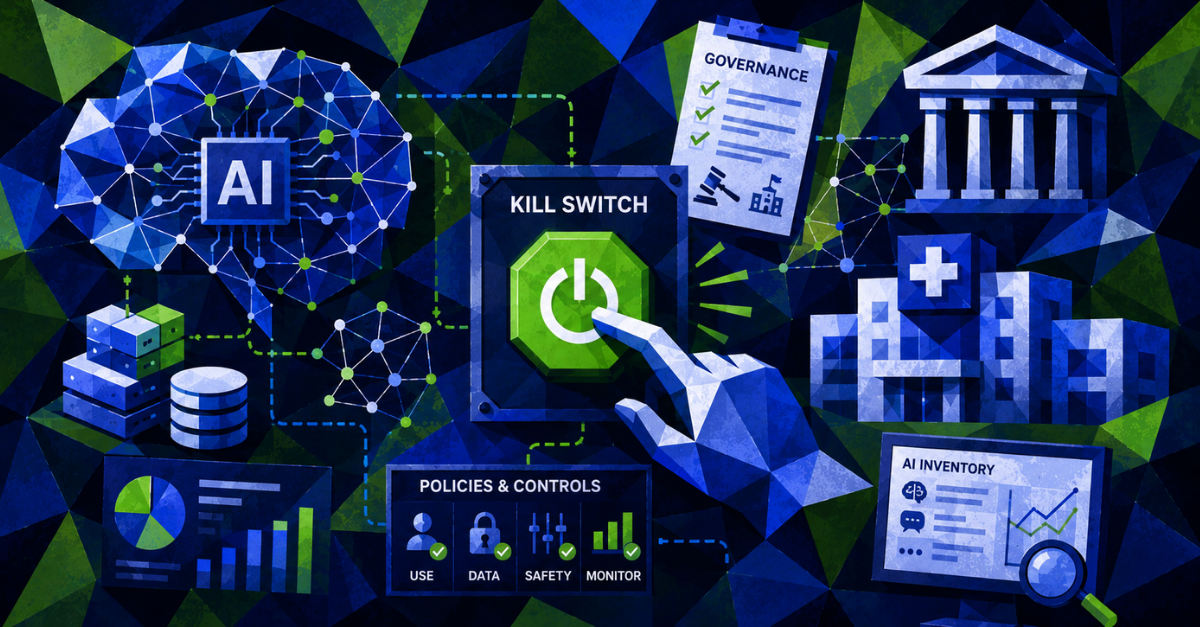
Vitea Command is the enforcement layer of the Vitea AI governance platform for healthcare. It applies 100+ healthcare-specific guardrails to every AI prompt and response in real time, blocking unsafe outputs before they reach a clinician, the EHR, or a patient, and logging every decision for audit and compliance reporting.
DLP and CASB tools govern where data moves. Vitea Command governs what AI is allowed to do. It reads the clinical and compliance context of a prompt or response, not just whether sensitive data crossed a boundary, catching things DLP structurally can't, like a hallucinated diagnosis or an out-of-scope treatment recommendation.
Most health systems have guardrails active within months. Command connects to existing infrastructure (for example, a forward proxy, ICAP integration with tools like Zscaler or Palo Alto, a browser extension, or an API/LLM gateway) so there's no rip-and-replace of your current security stack.
See how Vitea helps healthcare organizations monitor, govern, and reduce AI risk.
Purpose-built for healthcare compliance and AI governance.
Identify, monitor, and mitigate AI risks across your organization.
HIPAA-ready, SOC 2 compliant, and built with enterprise security at the core.






























.png)






.png)


.png)