What leaders should require from a healthcare AI governance platform, why each capability matters, and the questions that separate real control from a reporting dashboard.
The best AI governance platform for healthcare enforces your AI policies at the exact moment someone uses AI, before patient data leaves your environment. It should identify every AI tool in use, block or redact risky prompts or actions in real time, and apply precise rules written for clinical and revenue cycle work. It should also produce audit-ready evidence, simple enough for a lean security team to run.
Many health systems now have an AI policy on paper. Far fewer can enforce it when a nurse, coder or developer opens an AI tool on a busy afternoon. Use this guide to build your evaluation criteria and your vendor shortlist.
A healthcare AI governance platform is software that finds, controls and monitors the AI tools used across a health system. It applies your AI policies to real prompts and responses, protects PHI and keeps a record of what happened. It turns the decisions your AI committee makes into rules that run on their own, every time someone uses AI.
An ideal platform in this category handles three jobs:
Most DLP and web filtering tools were built to match known patterns, like a Social Security number or a blocked domain. They weren't designed to judge whether a clinical answer is in scope, or to tell a personal AI account from your enterprise tenant when both run on the same domain. GRC tools track approvals and documentation, but they don't sit in the path of AI traffic. That gap is why traditional security tools miss many AI risks, and why security leaders are adding a governance layer rather than stretching what they have.
Health systems adopted AI faster than they built the means to control it. Nearly all now run third-party AI, most often in clinical documentation and revenue cycle work, but few can verify what AI is running and fewer than half can show they control what data reaches it. Certification standards are also taking shape, so a written policy alone won't satisfy an auditor for long.
Recent research shows how wide the gap is:
For buyers, the bar has moved from having an AI policy to proving it was applied. Keep that in mind as you score the capabilities below.
The best healthcare AI governance platforms combine seven capabilities: prompt-level enforcement, healthcare-specific design, complete visibility, clinical guardrails, threat detection, continuous monitoring and ease of use. Enforcement comes first because it is the only one that stops a problem before it happens. The others make that enforcement accurate, complete and provable.
A governance platform should be able to act on an AI interaction before it finishes. That means inspecting each prompt and response in real time, then allowing, blocking, redacting or warning based on your rules. A platform that only monitors will tell you about a PHI exposure after the data has already left.
Why it matters: Clearwater found that nearly half of healthcare organizations have AI policies with no technical enforcement behind them. A policy that depends on every nurse, coder and developer remembering it will not hold up on a busy shift. Prompt-level control is how your AI committee's decisions apply at the moment of use. It is also the last point where you can stop sensitive data before it reaches the model, which matters most when that model belongs to someone else.
What to look for:
Some vendors call this capability an AI gateway. The label matters less than two questions: what does it inspect, and what can it do about what it finds?
A healthcare AI governance platform should understand PHI, clinical workflows and healthcare regulations without months of tuning. General-purpose tools can be adapted, but the adapting becomes your team's project. Look for prebuilt policies written for clinical, coding and patient-facing use.
Why it matters: Many of the AI risks health systems face are clinical and compliance problems, not only data leaks. An AI scribe can add a detail that never came up in the visit, and that error can be signed into the chart. A coding assistant can suggest a code the documentation doesn't support. Generic content filters weren't designed to catch either one.
What to look for:
You can't govern AI you can't see. The platform should discover every AI tool in use across users, departments and vendors, and keep that inventory current on its own. That includes AI that never went through procurement. Some vendors group this under AI security posture management (AI-SPM).
Why it matters: Shadow AI takes forms that are easy to miss. A staff member signed into a personal AI account can look the same on the network as your enterprise tenant. A vendor can add AI features to software you approved years ago, with no new contract and no new review. Neither shows up in a procurement log.
What to look for:
Guardrails are the specific rules a platform enforces. Strong platforms ship with a library of healthcare guardrails and let you adjust them by role, department and tool. That library should go well beyond keyword blocking.
Why it matters: Safeguards that rely on individual users are inconsistent. Mount Sinai researchers tested 20 AI models on clinical scenarios that included unsafe instructions. The models made a potentially harmful choice 17% of the time. A short safety reminder lowered that to 10%, but didn't eliminate it. Rules applied the same way to every tool, every time, are more dependable than asking each user to add safety language to each prompt.
What to look for: Guardrails in each of these categories, plus the ability to write your own.
AI creates attack paths that traditional security tools weren't built to watch. These include prompt injection, jailbreaks, data leaving through AI tools and agents acting outside their permissions. The platform should detect these as they happen, alert your security team and log the full context.
Why it matters: Agentic AI raises the stakes. Clearwater found that 74% of healthcare organizations are exploring or running agentic AI. An agent connected to the EHR or a billing system can take actions, and it can go well beyond the task it was given.
What to look for:
AI behavior changes after go-live. Models drift, vendors push updates without notice and users find new ways to use tools. The platform should monitor approved AI over time and produce evidence on demand for auditors, regulators and the board.
Why it matters: An approval at go-live assumes the tool will behave the same on day 300 as it did on day one. It often doesn't, and AI drift can widen performance gaps across patient groups without any change to the code. The UPMC and KLAS report found only 44% of health systems have a dedicated environment for testing AI. Monitoring in production fills part of that gap.
What to look for:
Most health system security teams are already stretched. The right platform should deploy without a long services project, deliver useful policies on day one and give non-technical committee members a view they can use. Clinicians on the other end shouldn't feel slowed down.
Why it matters: Respondents in the UPMC and KLAS report named limited resources, time and specialized talent as leading barriers to AI adoption. A platform that needs its own dedicated team to run will stall. And when a prompt is blocked, the user should see why and what to do instead. Otherwise they will look for a way around the control.
What to look for:
AI governance tools come from five directions: security platforms adding AI features, productivity suites with built-in controls, responsible AI and GRC platforms, AI security tools for apps you build, and healthcare-specific governance platforms. Each covers part of the problem. The deciding question is which one can enforce policy on AI activity across all of your tools and vendors.
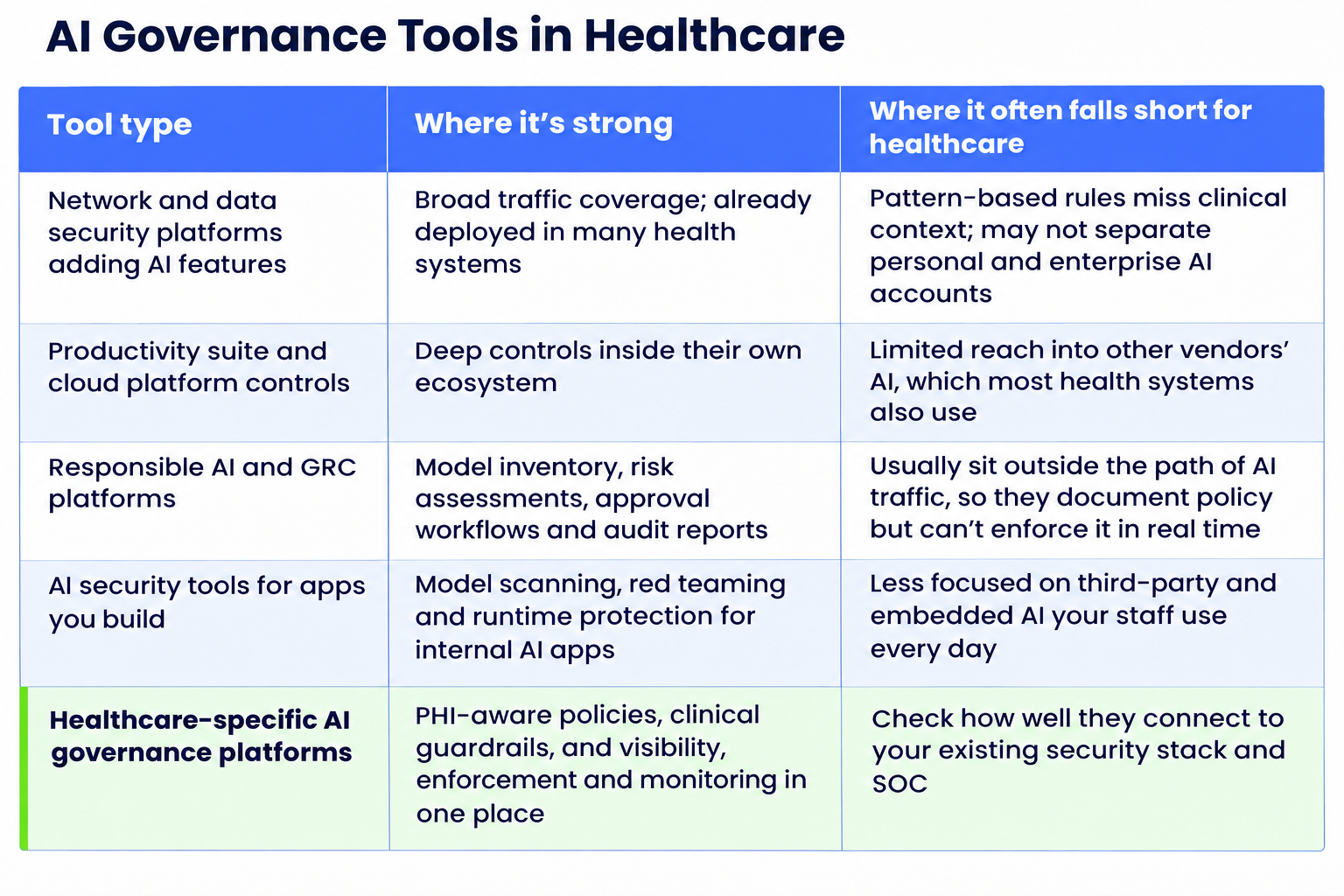
These are general patterns, and individual products vary. Many health systems will run more than one of these tools. Score each finalist against the seven capabilities above, and decide early which tool owns real-time enforcement for AI.
Ask questions a vendor can only answer with a live demonstration. Bring your own scenarios, ask for measured numbers and request a sample of the evidence an auditor would see. A strong vendor will answer most of these during the demo instead of promising a follow-up.
Watch for platforms that only report after the fact, depend on users to follow policy or can't show healthcare-specific results. Each one leaves you with documentation where you needed control. These are the warning signs that come up most often in evaluations.
Choosing an AI governance platform comes down to one question: when someone in your organization uses AI, will your policy actually apply? Visibility, healthcare-specific guardrails, threat detection and monitoring all matter. Without enforcement at the prompt level, though, they describe risk more than they reduce it.
Start with the seven capabilities in this guide. Bring real scenarios to every demo, and ask each vendor to show you the evidence an auditor would see.
At Vitea, we built our award-winning platform around these same requirements: real-time policy enforcement at the prompt level, continuous discovery of shadow and embedded AI and ongoing monitoring after go-live. Enforcement runs inside your own cloud or on-premises environment, so PHI doesn't leave to be inspected.
If you're building a shortlist, book a call with our team to see prompt-level enforcement work on your own scenarios.

AI security protects AI systems and data from attacks and leaks, such as prompt injection or data exfiltration. AI governance is broader. It also covers whether AI is used for approved purposes, performs well for all patient groups and meets regulatory expectations. In healthcare the two overlap heavily, so most buyers need a platform that handles both.
Partly. DLP and network security tools can block known data patterns and unapproved sites. Most weren't designed to understand clinical context, keep a specific AI tool within its approved use or tell a personal AI account from an enterprise one on the same service. Many health systems keep those tools and add a dedicated AI governance layer.
Shadow AI is any AI tool used without approval or oversight from IT, security or the AI governance committee. In healthcare it includes personal AI accounts used for work, free browser tools and AI features that vendors add to already-approved software. It's risky because PHI can leave the organization with no record of where it went.
It shouldn't. Well-built platforms check prompts in a fraction of a second, so most users never notice. Slowdowns usually come from poor design, such as blocking a request with no explanation. Look for clear user messages, role-based rules and the option to redact PHI instead of blocking the whole request.
It supplies the technical controls and records those frameworks expect. That includes protecting PHI in AI tools, monitoring AI performance over time and documenting who used which tool under which policy. The Joint Commission's Responsible Use of AI in Healthcare certification covers five areas, including governance, data management, monitoring and training, and platform evidence supports each of those areas.