At least seven states now require government to account for the AI it uses, and most others are likely to follow. For state-run hospitals, health agencies and the organizations that depend on state funding, an accurate AI inventory is becoming a basic expectation. It is also only the first step.
For the past few years, much of AI governance in healthcare has run on guidance: frameworks, principles and voluntary standards. That is changing. State legislatures have started writing AI oversight into law, and the first thing they ask for is consistent from state to state. Before an agency can assess, disclose or restrict its AI, it has to produce a complete inventory of the AI it uses.
That sounds simple, and it rarely is. In a recent Clearwater survey, 91% of hospitals said they had no way to know what AI is running on their systems, let alone control how it behaves. Further, one in five organizations has already had a breach caused by shadow AI, according to IBM.
The details vary, but each of these laws starts from the same premise: government has to know what AI it is running. Of the states with inventory requirements, these five have the most recent ones.
California and Vermont run their own government AI inventories, and California's experience is a useful warning, covered below.
These laws are written for government, and in healthcare that covers a lot of ground. Depending on the state, the organizations already in scope can include:
Their reach also extends past the agencies themselves. Texas already applies parts of its law to vendors. Requirements placed on agencies tend to work their way into procurement terms, grant conditions and vendor security questionnaires. Medicaid managed care plans, contracted providers and technology partners should be ready to say what AI they run, and to back it up.
The pattern is hard to miss. Vermont was early. California and Connecticut passed inventory requirements in 2023, Maryland in 2024, and New York, Texas and Kentucky in 2025. The newer laws ask for more than a list. They add risk classification, impact assessments, public disclosure and, in Texas, obligations for vendors.
Federal agencies already work under the same expectation. Under the 2023 National Defense Authorization Act and OMB guidance, they publish annual AI use case inventories. In 2025 they reported 3,611 use cases, up from 1,757 the year before.
Accreditation is moving the same way. The Joint Commission's voluntary Responsible Use of AI certification, launched in June 2026, surveys AI much as it surveys a hospital. Assessors pick a tool out of the organization's AI inventory and trace it from the contract through daily use.
I think it's a matter of time before most states adopt some version of these rules, and before the expectation reaches the organizations that contract with them or depend on their funding. Organizations that build an accurate inventory now will have an answer when the request arrives. The ones that wait will be building it against a deadline.
Many organizations start with a survey. They ask department heads what AI they use, compile the answers and call the result an "inventory." That method tends to miss the AI that carries the most risk.
California shows why. When the state first ran its inventory of high-risk automated decision systems, agencies reported none. According to researchers from UCLA and Georgetown Law writing in CalMatters, agencies were in fact using at least six such systems. One they cite was never reported: a model that makes risk predictions about Medi-Cal patients. The law relied on agencies reporting on themselves, with no way to verify the answers.
Three kinds of AI rarely show up in a survey:
The gap can be large. In one major health system we work with, leaders estimated they had about 30 AI applications. When Vitea Lens analyzed the network, it found more than 120, and at least 90 of them were running without any monitoring.
An accurate AI inventory has to come from what is actually happening on the network, and it has to stay current. Federal agencies doubled their reported AI use cases in a single year. An inventory finished in December can be out of date by spring.
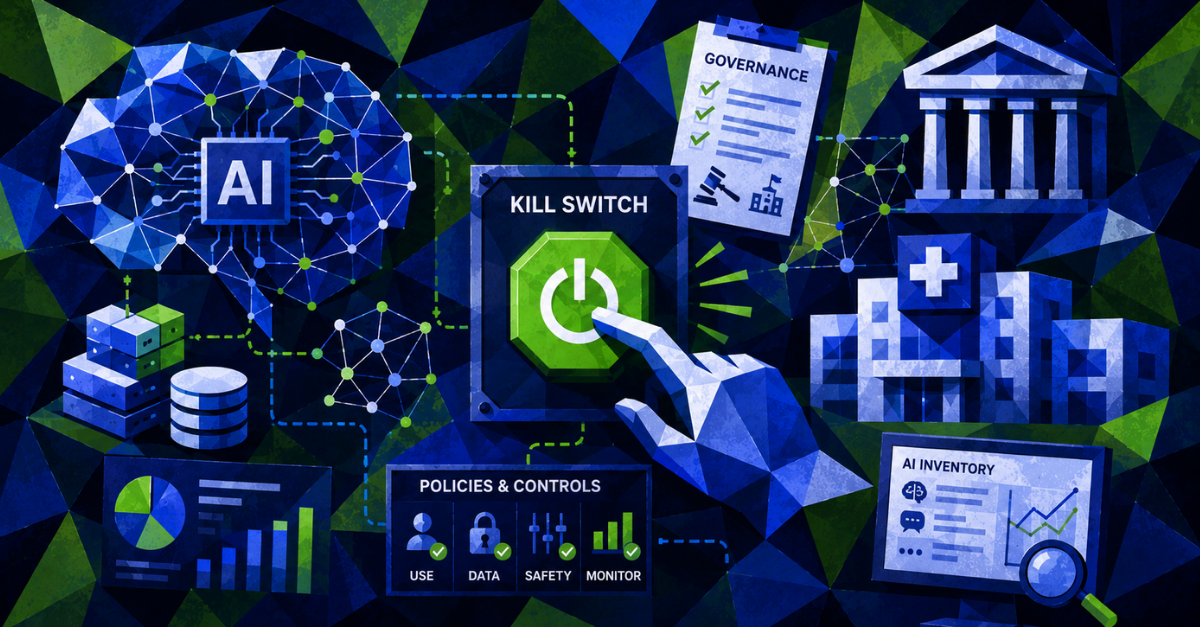
An inventory tells you what AI is running. It still doesn't control what that AI does. A list can show that an ambient scribe is live in a dozen clinics, but it can't tell you when the scribe writes a detail into a note that the patient never said. It can show that staff use an AI assistant, but it can't tell whether patient data just went into a personal account instead of the enterprise one.
That is why Vitea, built specifically for healthcare, works in layers.
First, Vitea Lens finds the AI. Lens automates AI inventory management, building a continuous, enterprise-wide inventory from the DNS, proxy and firewall logs an organization already keeps. There are no agents to install, and first insights arrive within 48 hours. Each application comes with its vendor, users, departments, facilities, data types, risk score and approval status, in records that can be exported for auditors and regulators.
Then, Vitea Command enforces policy on it. Command inspects every AI prompt and response as it happens and applies policy before the output reaches a patient, clinician or EHR. It starts with more than 100 healthcare-specific guardrails covering clinical scope, PHI protection, coding integrity and regulatory compliance. Teams can add their own policies in plain English. Enforcement adds less than 500 milliseconds at the 95th percentile. Command connects through infrastructure already in place, such as a forward proxy, an ICAP integration or an LLM gateway, and writes every decision to an audit trail.
Most tools in this market cover one part of the job. Network security tools govern where data moves. Governance registries record which tools have been approved. Neither decides, at the moment a prompt is sent, what an AI tool is allowed to do in a clinical setting. Command was built to make that decision, which is what turns the inventory Lens produces into controls an organization can enforce.
State inventory laws are the clearest sign yet that healthcare AI governance will be judged on evidence. Today they reach state agencies and state-run hospitals. The organizations that contract with those agencies, or depend on state funding, are likely next.
The work is the same either way. Good AI inventory management means finding every AI system in use and keeping that list current. Governance means enforcing policy on what those systems do. Organizations that start now will have the answer ready when someone asks for it.
To see inventory management and real-time policy enforcement on the AI already running in your organization, book a call with our team here.