Epic's release pace has turned the AI governance committee into a capacity problem. Health systems that keep reviewing AI the old way will end up slowing everything down, or quietly approving tools they no longer have time to examine.
In August, Epic used its Users Group Meeting to show health systems how much of its AI roadmap had already shipped. Art-generated summaries were live at more than 300 organizations. Agent Factory, Epic's platform for building and running AI agents, came with roughly 120 AI capabilities that customers can deploy as-is, modify, or use as a starting point for agents of their own. Epic also showed an analyst build assistant that reviews a customer's configuration against Epic guidance and recommends changes. On the roadmap, the same tool eventually makes those changes, troubleshoots problems and tests its own work.
Health system CIOs were largely impressed. They were also uneasy, and Becker's Hospital Review captured why. Ohio State Wexner Medical Center's Tom Bentley called the pace "blistering." Avera Health's Bruk Kammerman said the real constraint is his organization's capacity for change. As Becker's framed it, the open question has shifted from whether the tools work to whether health systems can adopt, govern and pay for them at this speed.
Those are fair concerns, and most of them trace back to one design assumption. The AI governance committees and review processes health systems have built over the past few years were calibrated for vendors that delivered significant change every year or two. According to Becker's, Epic now ships new features each quarter, where the cadence used to run closer to 18 months. The outlet has since tracked 34 new Epic features and their expected release windows.
A governance model tuned to the old clock can fail in two ways. It can become the bottleneck every CIO is worried about, or it can start approving things it no longer has time to examine. Neither outcome is acceptable for tools that draft clinical notes and help shape treatment decisions.
Mass General Brigham's chief health information officer, Rebecca Mishuris, MD, described a shift that should concern every AI governance committee. A decision to hold off on a feature used to stand for about a year. Now it comes back up for review in roughly three months.
Approvals deserve the same treatment, and few committees give it to them. A committee that cleared an ambient documentation tool last spring evaluated a particular model, feature set and workflow. Two quarterly releases later, the tool may summarize differently, draw on new data sources, or include capabilities that did not exist when the committee signed off. The approval is still in the minutes. What clinicians are using may no longer match what was approved.
Epic AI governance is the most visible example, but the pattern runs across the enterprise software stack. Vendors are adding generative features to products health systems approved years ago, usually through routine updates that never trigger a procurement review or a fresh security assessment. A scheduling platform, a revenue cycle tool or a collaboration suite can pick up AI capabilities between one contract renewal and the next. In most organizations, no one is assigned to notice.
The first pressure point is people. Providence's Cherodeep Goswami warned that when features arrive faster than staff can be trained on them, uneven training becomes a patient-care risk. Clinical informatics and IT analyst teams, already stretched by regular upgrades, are now also fielding requests to pilot, validate and support a growing list of AI features.
The second is ownership. Agent Factory is a credible answer to IT build backlogs, and at least one large system plans to certify its own staff to build on it. Fierce Healthcare reports that early adopters are already using the platform, with broad availability expected in 2027. Once that happens, a single health system could be running dozens of agents assembled by different teams, each adapted from a template and each acting on patient data. Newsweek's UGM coverage raised the question every CIO will eventually have to answer: Who is responsible for keeping an agent safe after it goes into production?
The third is cost. UVA Health's Sonney Sapra said that tracking token usage and projecting AI spend will shape which tools his organization adopts in the first place. Other CIOs raised the possibility that AI moves spending from labor to compute without shrinking the total. Few health systems have the metering in place to know which way a given tool is trending.
The CIOs who sounded most settled had already changed how their organizations make decisions. Their approaches, along with practices emerging in mature AI governance programs, point to five changes.
UW Health's Michael Waisbrot reserves deep review for features that are genuinely new and fast-tracks those that resemble capabilities already approved. Of everything on this list, this does the most to protect committee time. It depends on a written definition of "similar," agreed on before the next release lands: same data, same users, same type of output, same degree of autonomy.
A feature that goes from drafting a note for clinician review to filing it without review is a new capability, even when the release notes call it an enhancement.
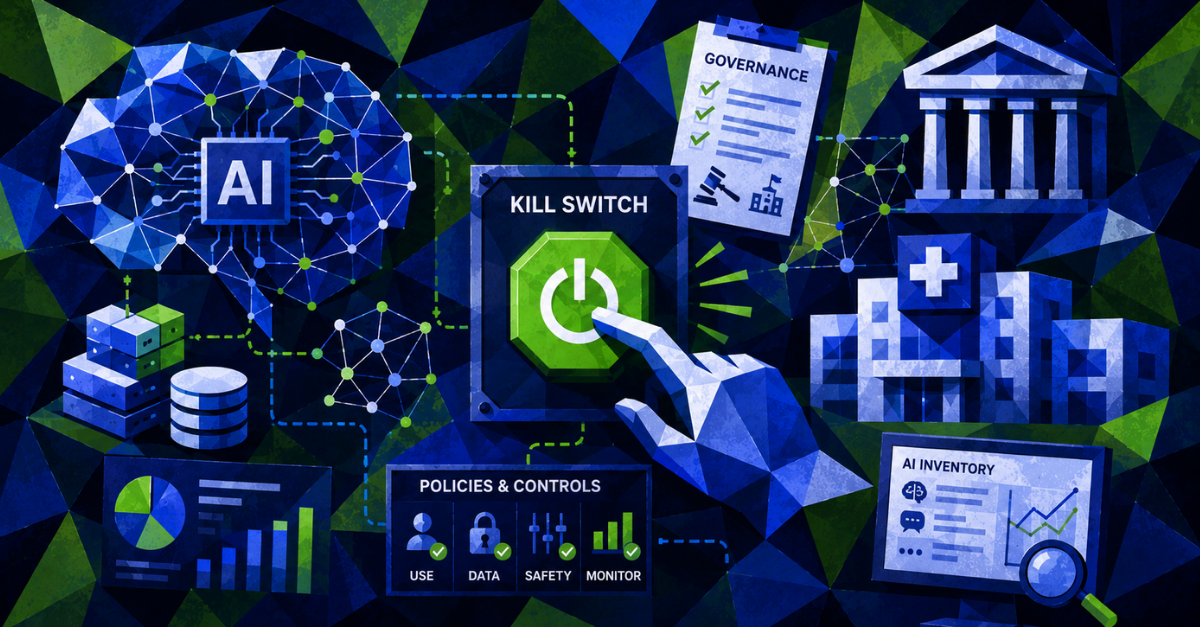
An approval recorded in meeting minutes protects the organization only as well as people remember it. The conditions a committee attaches to a tool, such as which data it may receive, who may use it and what it may generate, can be written as policies and enforced automatically at the point of use.
When those conditions travel with the tool, committees can approve faster. The approval carries limits that hold at 2 a.m. on a short-staffed unit as reliably as they do in the conference room where they were agreed.
Point-in-time review assumes the tool will stay the same, and it won't. Approvals should carry a reassessment date tied to the vendor's release cycle, and continuous AI monitoring should flag when a tool's capabilities or behavior change between reviews. An ambient scribe that starts adding a medication the patient never mentioned will not show up in any vendor's release notes. It will show up in the chart, which is why monitoring has to happen in production.
AI agent governance starts at registration. Health systems should decide now what it takes to register an agent: a named business owner, a clinical or operational sponsor, the data it can read, the actions it can take, and the conditions under which it gets retired. Building an inventory after agents have multiplied across departments is far harder than requiring one from the start.
Token consumption should be forecast before deployment and reviewed alongside other operating expenses. A tool that saves clinicians real time can still come out behind at enterprise scale if no one meters its use.
In the same keynote, Epic told customers that the traditional 30-day security patch cycle is no longer fast enough. AI governance in healthcare is getting the same message from the same vendor. The health systems that do well over the next two years will run governance as operating infrastructure, with its own capacity planning, staffing and tooling. A committee that meets monthly and hopes the agenda stays short will not keep up.
None of this lowers the safety bar. It moves the committee's hours toward capabilities that are new and carry real risk, while decisions already made are encoded to enforce themselves and monitoring catches what shifted in between.
A practical place to start: At the next AI governance committee meeting, pull every AI approval from the past twelve months and check how many still describe what is running today.
Ritesh Sharma is chief operating officer of Vitea, an AI governance platform built for healthcare that enforces AI policy in real time at the point of use.